
FINALLY, AN AFRICAN CREDIT RATING AGENCY THAT COULD CHANGE HOW WE PRICE ADAPTATION
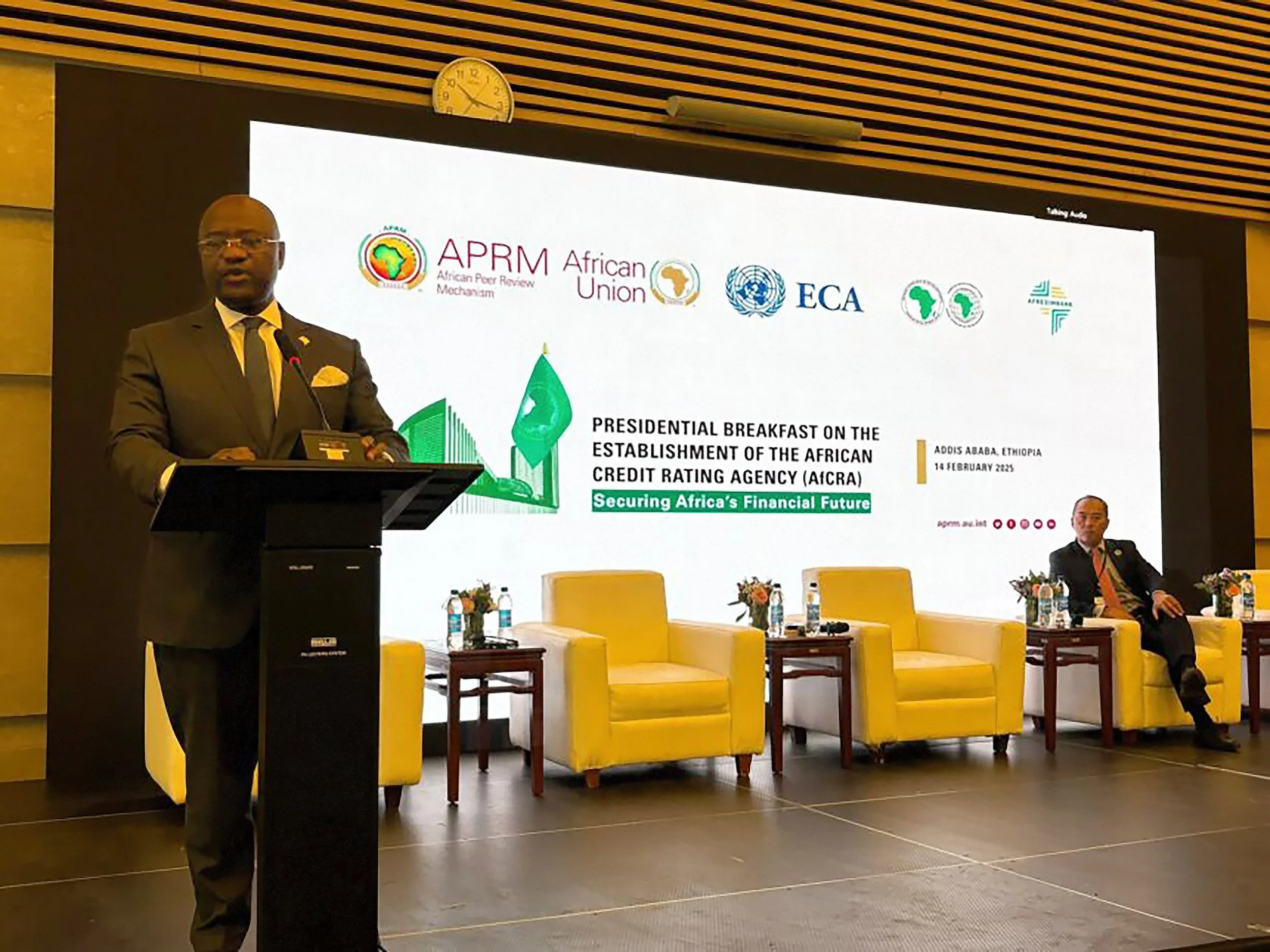
Presidential Breakfast on the Establishment of the African Credit Rating Agency (AfCRA), 14 February 2025, Addis Ababa, APRM.
BY PETER WANYANGI
Africa is about to get its own credit-rating agency, and how it chooses to assess climate risk could have major implications for the cost of borrowing across the continent.
The African Credit Rating Agency (AfCRA), endorsed by the African Union in February 2025, is intended to assess the creditworthiness of African governments and companies using data and indicators that better reflect African economic conditions. Its approach could also determine whether countries receive financial recognition for investing in measures that protect them from climate-related losses.
AfCRA is scheduled to launch on 7 October 2026 in Mauritius, which will host its headquarters, immediately after the 2nd Africa Annual Conference on Credit Ratings in Port Louis on 5 and 6 October. The agency is being established partly in response to the high borrowing costs faced by many African countries, which are often linked to perceptions that they are riskier than their economic fundamentals suggest. The African Development Bank has argued that much of Africa's risk premium is based on this perception, although African sovereigns continue to face relatively high borrowing costs in financial markets.
AfCRA’s evolving methodology offers a unique opportunity to fix a secondary mispricing tied to climate finance. By explicitly factoring physical climate risk and adaptation investment into its core evaluation framework, AfCRA could usefully adopt an ‘adaptation-smart’ approach, accounting for both the economic vulnerabilities climate change causes and the risk-reducing benefits of verified resilience investments. This dual focus is not yet standard practice among major global rating agencies.
"The Impact of Physical Climate Risks and Adaptation on Sovereign Credit Ratings," University of Oxford — Smith School of Enterprise and the Environment / Environmental Change Institute (ECI), 2024.
Physical climate hazards already constitute material credit risks. Droughts, floods, cyclones and heatwaves damage infrastructure, depress economic output and strain public budgets. Dominant global agencies like Moody’s, S&P Global and Fitch integrate physical climate threats through indicators and scenario analysis, but rarely grant consistent, systematic credit for adaptation measures that reduce these risks. The methodological gap creates a major opening for AfCRA to assess not only exposure to climate hazards, but also whether effective adaptation measurably reduces the economic and fiscal losses tied to them.
Research indicates that climate-driven downgrades could affect dozens of countries’ rating by 2030, with effects growing more pronounced under high-emissions pathways. For African economies, where climate-sensitive sectors, infrastructure and public finances are highly exposed, this can create a reinforcing cycle where greater vulnerability elevates fiscal and credit risk, higher perceived risk raises borrowing costs, and higher borrowing costs further constrain the fiscal space for adaptation. This is particularly important as Africa’s broader climate-finance needs are estimated at up to $277 billion annually yet tracked flows reached only around $43.7 billion in 2021/22, leaving adaptation critically underfunded. A methodology that rewards verified resilience could help break this cycle.
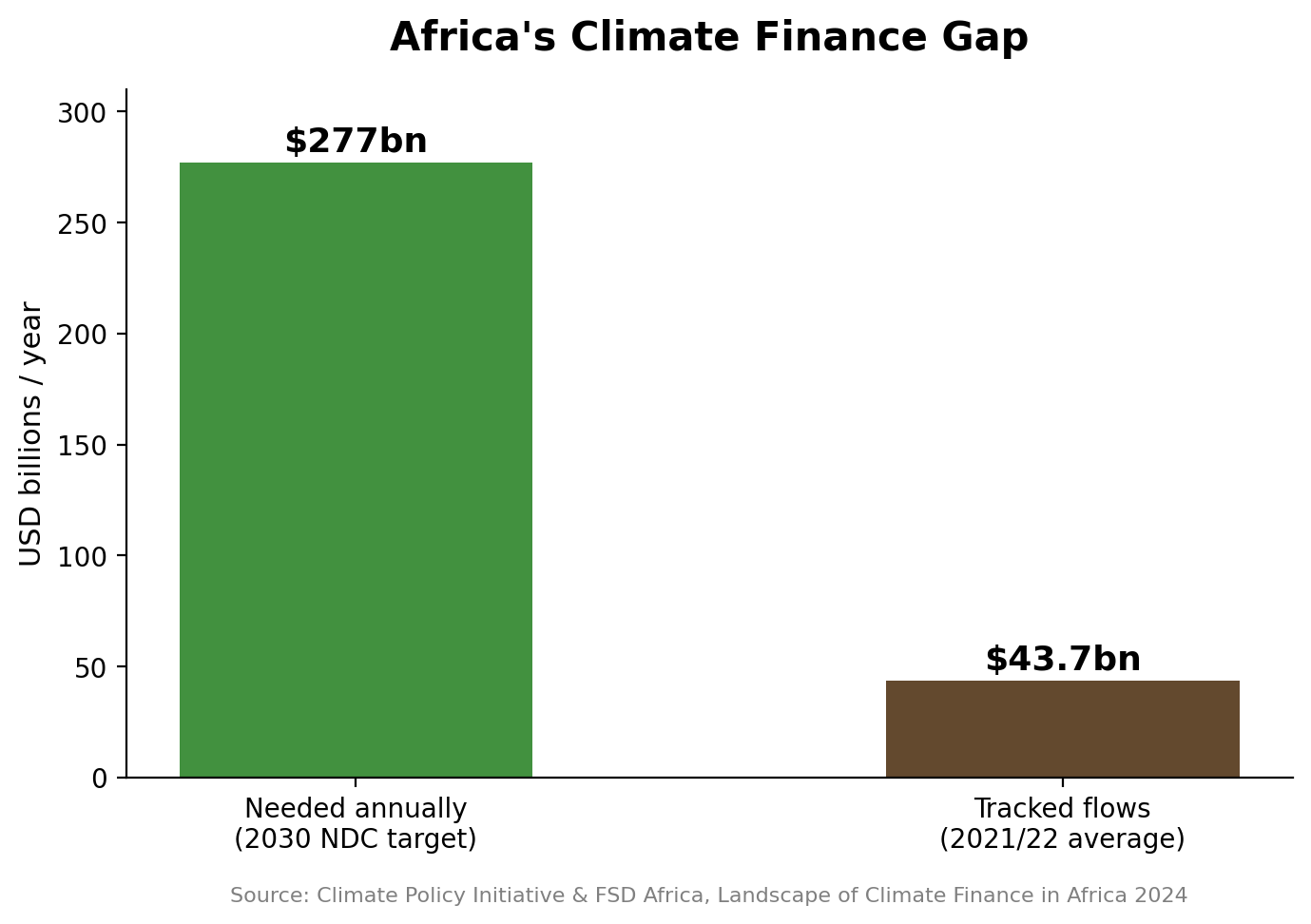
"Africa's Climate Finance Gap" — needed vs. tracked flows (CPI/FSD Africa data)
Evidence that adaptation investment can positively affect sovereign credit profiles is emerging. Modelling by Oxford’s Environmental Change Institute (ECI), using Thailand as a case study, linked catastrophe-risk, macroeconomic and credit-rating models, and found that severe flooding threatened Thailand’s sovereign rating under both present and future climate scenarios. Comprehensive national flood adaptation measures, however, reduced projected average annual capital losses by up to 64% and cut the 10-year probability of the country falling below investment grade from over 6% to under 1% under a high-emissions pathway. While these findings are preliminary and specific to Thailand, they demonstrate a useful proof of concept for integrating adaptation into sovereign credit profiles.
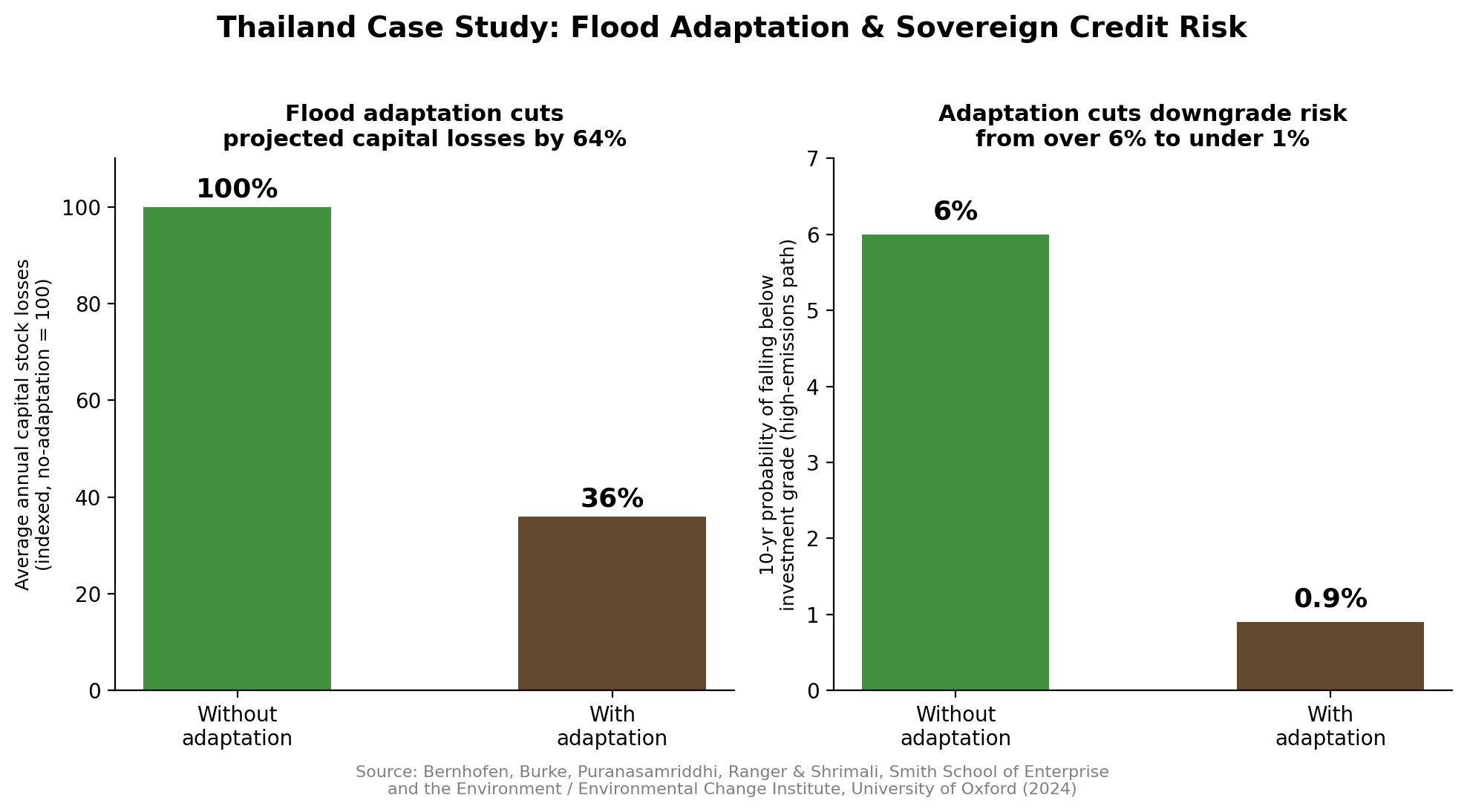
"Thailand Case Study: Flood Adaptation & Sovereign Credit Risk" — the 64% loss-reduction and 6%→under 1% downgrade-risk figures from the Oxford ECI paper.
Translating this evidence into AfCRA’s methodology could involve four practical steps:
Develop a standing climate-risk module that uses forward-looking catastrophe modelling calibrated to Africa’s main hazards (cyclones on the southern and south-east coasts, drought across the Sahel and Horn of Africa, flooding in major river basins) to quantify the potential economic and fiscal exposure. This module can leverage existing regional frameworks, such as the data models used by the African Risk Capacity (ARC) Group, ensuring the risk metrics are grounded in established African climate realities.
Give measurable credit for adaptation investment by assessing whether specific measures such as flood protection and early-warning systems demonstrably reduce the losses the risk module identifies and use that reduction to inform the rating.
Build a shared African climate and financial data architecture with finance ministries and climate institutions to overcome fragmented data and make assessments credible.
Publish clear, auditable criteria showing how climate risk and adaptation investment affect rating, building investor confidence through transparency.
A practical approach would be to pilot the climate-risk module on a small group of highly exposed economies and gradually extend it, phasing in adaptation recognition as data-sharing arrangements mature. This is feasible; catastrophe modelling exists and can be adapted, and transparent criteria and progressive piloting are realistic for a new agency.
AfCRA faces real obstacles here. Specifically, African climate data is scattered and proving how adaptation measures reduce financial risk could be challenging, yet investors will need full transparency to trust the framework. Rushing this could backfire; if AfCRA’s early ratings differ wildly from major global agencies without clear proof, it could damage the pathway's credibility right from the start.
Under this approach, the rating itself would form part of the broader climate-finance architecture, signaling the value of resilience investment to investors. It would not, however, substitute for other forms of support as Africa’s adaptation requirements cannot be met through better-priced private capital alone. Grants, concessional finance and other public resources remain essential for highly vulnerable countries with limited fiscal capacity. Adaptation-aware ratings would complement, not replace, these sources
Climate change already heavily influences African creditworthiness. The open question is whether AfCRA’s approach will ultimately reflect both the costs of climate change and the value of measures that reduce them, and whether the pathway the agency was established to create will be successfully realized for climate finance.
Peter Wanyangi is a Climate Finance Project Officer at Power Shift Africa.