Africa’s Renewable Future: The Money Is Finally Moving — is it Enough, Fair and Free?
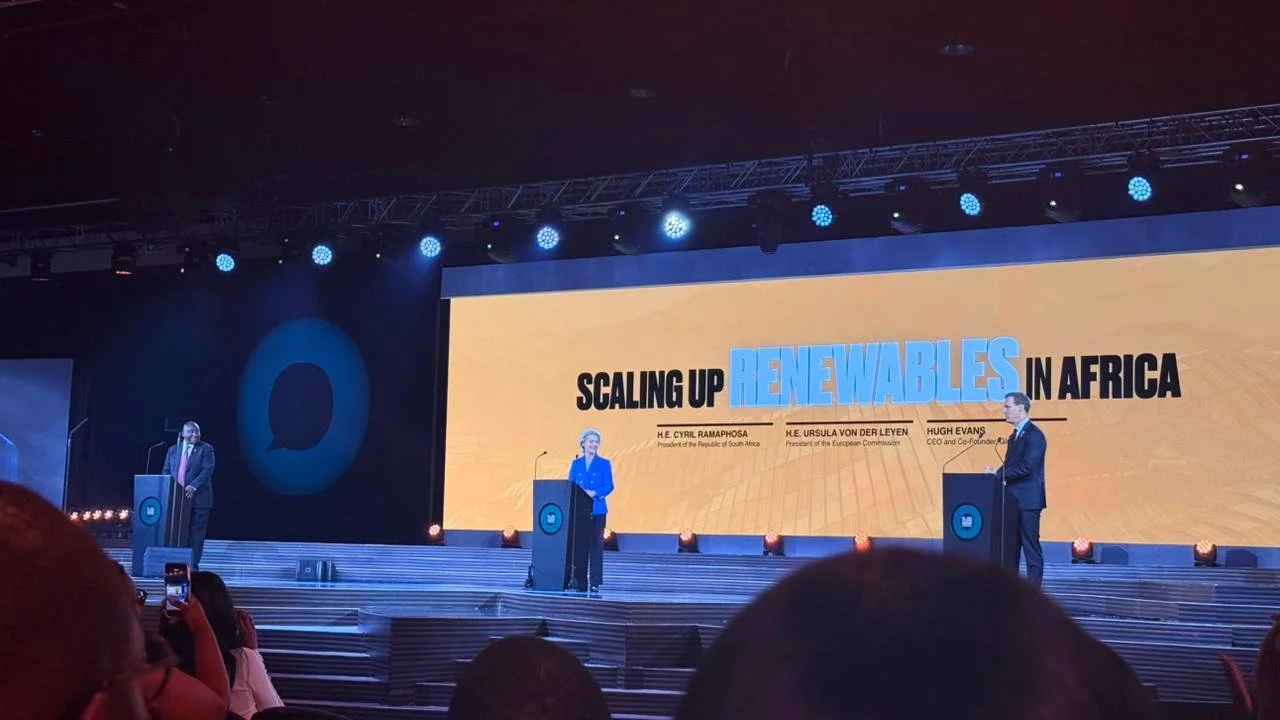
South African President, European Commission President and Global Citizen CEO at Global Citizen Now in Johannesburg last week.
Last week, at the Global Citizen NOW event on the sidelines of the G20 Leaders Summit in Johannesburg, the political energy around Africa’s renewable future shifted.
South Africa’s President Cyril Ramaphosa and European Commission President Ursula von der Leyen stood side by side to trumpet a new wave of commitments from the bloc for the Scaling Up Renewables in Africa campaign, a push that aims to finally unlock the clean energy revolution Africa has been waiting for.
The headline figure is striking: €15.5 billion, pledged by developed countries to support Africa’s renewable transition. For a continent that is chronically starved of climate finance, this number represents momentum.
But it’s the details that matter. The mix of finance instruments matters. What matters even more is the politics of what world leaders, particularly within the G20, consider “renewable” energy.
Most of the public finance announced came from Team Europe, which arrived with a substantial €13 billion package stitched together from EU institutions, development banks, and member states. It includes grants, concessional loans, equity and guarantees, along with an estimated €2.1 billion in private sector leverage.
A familiar tension, however, lingers. How much of this is ‘‘real money’’ that Africa won’t have to repay? How much of it is simply more debt disguised as climate support?
Without clarity on these questions, Africa should approach the deal with cautious enthusiasm.
Norway pledged 3.1 billion Norwegian Krone (NOK 3.1 billion, or approximately €270 million) to the campaign. The figure is modest compared to the country’s enormous profits from oil and gas exports.
Meanwhile, the African Development Bank will allocate 20 percent of its ADF18 replenishment to renewable energy. While it’s a significant sum, the figure will depend on replenishment outcomes.
The private sector stepped up with its contribution to ambition.
| COMPANY | INVESTMENTS |
|---|---|
| Harith General Partners | Grow capacity from 1.5 gigawatt to 5 gigawatt |
| Octopus Energy | $450 million to Africa Power Fund |
| Cross Boundary Energy | $200 million to renewable pipeline |
| Enertag | 1.2 gigawatts of clean energy in South Africa |
| Scatec | 10 gigawatts, focus on Africa |
| Sun King | 50 million off-grid solar products by 2030 |
This is the scale Africa has been demanding: renewable systems that increase energy access, strengthen grids, decentralise power, and build resilience. With private capital, however, safeguards are important. Without them, Africa risks repeating the old, familiar pattern where profits exit the continent faster than electricity arrives.
But the biggest political shadow hanging over the entire moment is the G20’s ongoing attempt to hold gas inside the definition of “clean” or “transitional” energy. Despite the science, the economics, and lived realities of African communities, all opposed to new fossil build-out, some G20 members still insist that gas has a legitimate role in a climate-compatible future. This framing is dangerous. To consider gas “clean” power is to bind African nations to fossil infrastructure, lock them into debt, volatility, and stranded assets.
African civil society has been unequivocal in their stance against gas as a transition fuel. Renewable energy means wind, solar, geothermal, and hydro, of which Africa is richly endowed. Developed countries must support Africa to develop these and sustainable storage to bridge the energy gap on the continent.
So what does this moment actually mean?
Africa’s renewable revolution is here. It is politically unavoidable and economically irresistible. The world must now reorient it focus on Africa. Developed countries must stop treating Africa as a fossil frontier and instead regard the continent as a clean-energy powerhouse.
This moment also means finance is moving at a pace we haven’t seen before. Still, nowhere near fast enough for a continent that needs ten times the current level of investment annually.
Politically, it means the G20 has the sway to shape or sabotage Africa’s clean energy future, depending on the relationship world leaders have with fossil fuels going into the future. Can they finally let go of the fossil illusion that has held global climate action back for decades?
The pledges made in Johannesburg matter. But what matters far more is what will happen next: whether that money becomes projects; whether projects become power; and whether power flows to communities that have been living in the dark and cold, rather than extractive multinationals.
Africa is ready.