Brick Wall: How Europe Blocks Climate Progress
If wealthy nations are guilty of triggering the climate crisis, they are twice as guilty of doing little to combat the breakdown while frustrating ambitious action.
From outright obstruction to lacklustre commitments, skulduggery and chicanery, industrialised countries always refer to their book of dark tricks to slow the world’s transition to a climate-compatible future and evade historical responsibility.
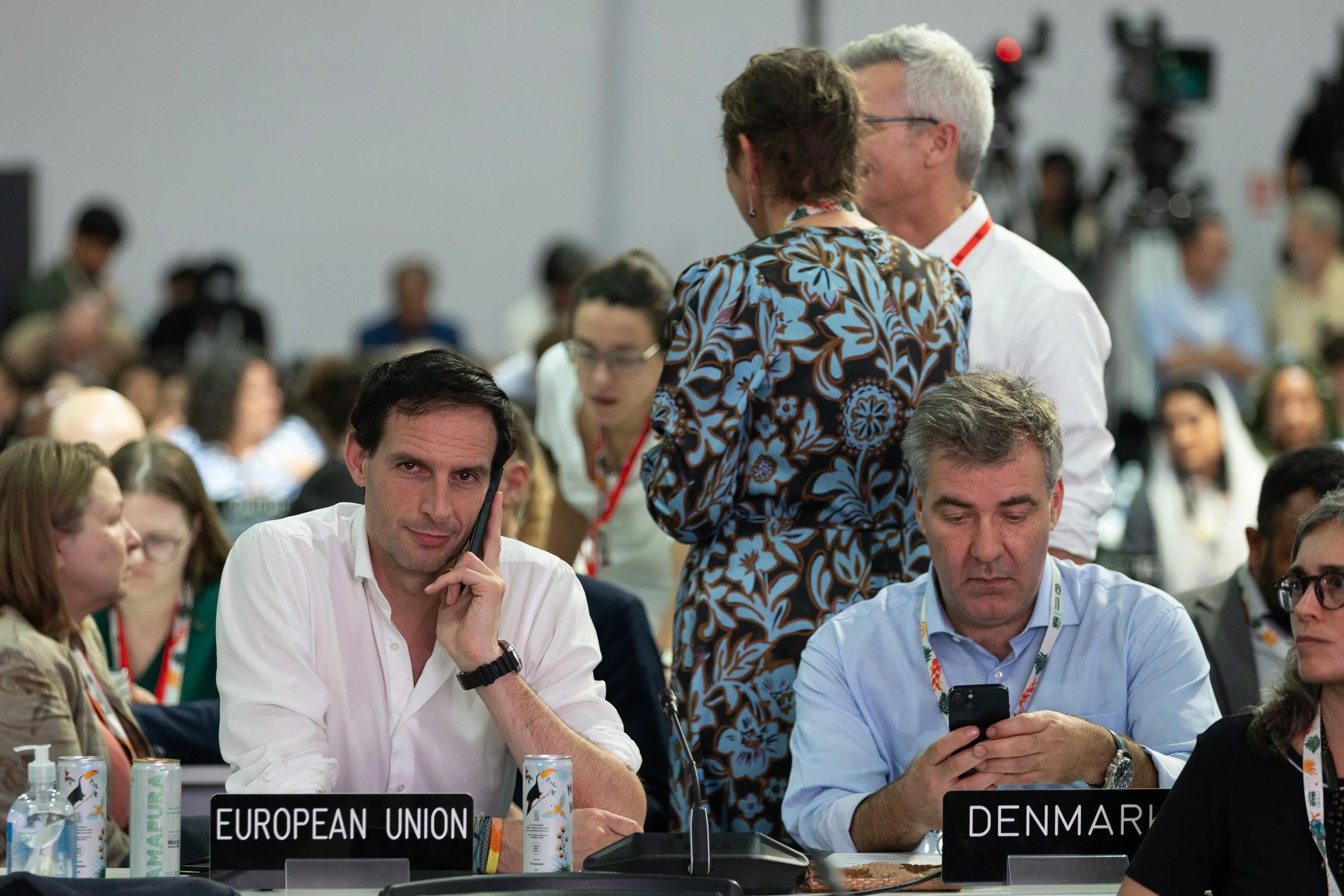
In this piece, we spotlight the European Union’s notoriety for playing three-dimensional chess to sink fair and equitable deals during climate meetings, including how the bloc deployed this now all-too-familiar tactic at COP30.
Weakened Adaptation Finance was one of the disappointing outcomes of the ‘‘Global Mutirão’’ agreement at COP30. The deal featured a ‘‘single and heavily diluted’’ paragraph on adaptation finance that ‘‘calls for efforts to at least triple adaptation finance by 2035’’, and ‘‘urges’’ developed country Parties to ‘‘increase the trajectory of their collective provision of climate finance for adaptation to developing country Parties.”
Saada Mohamed, a Climate Finance Associate at Power Shift Africa, says the summit outcome undermined developing countries’ demand for equitable, fair, and predictable public climate finance from their developed counterparts.
‘‘[The outcomes’] weak language set one of the worst precedents in the history of the negotiations by failing to specifically refer to the legal mandate of rich countries to provide public finance for adaptation under the UN climate regime (the Convention),’’ Saada says.
Harjeet Singh notes that while the architecture to address the climate crisis is in place, developed nations still fail to meet their obligations. The founder of Satat Sampada Climate Foundation likens Europe’s climate support to developing countries to a children’s game.
‘‘Withholding the finance to power [action], rich nations are setting the Global South up to fight an inferno with a water pistol. This is a betrayal of the world's most vulnerable,’’ Harjeet says.
Delayed Action Timelines. At COP26 in Glasgow, developed countries committed to doubling adaptation finance by 2025 from 2019 levels, under the Glasgow Climate Pact. This would have seen adaptation finance flows to developing countries hit $40 billion annually by this year.
By agreeing to triple adaptation finance by 2035 at COP30, however, wealthy nations shifted the goalposts by a decade, while leaving the doubling pledge unfulfilled. This signifies a lack of urgency in both the provision of critical finance support to climate-impacted countries and ambitious emission reduction plans.
Over the years, kicking the climate ambition can down the road has been Europe’s game plan in climate talks, even as climate impacts and devastation rise. Director of Power Shift Africa, Mohamed Adow, dismisses Europe’s ‘climate leadership’ for failing to honour its commitments at COP30, noting that ‘‘roadmaps and workplans [mean] nothing’’ in the absence of ‘‘real finance and real action’’ to support poor, climate-vulnerable nations.
“Developed countries have betrayed vulnerable nations by both failing to deliver science-aligned national emission reduction plans and also blocking talks on finance to help poor countries adapt to climate change,’’ Adow says.
Unfair Finance Systems and broken promises, like the $100 billion goal, are largely responsible for the sluggish flow of resources to countries that need them most to address climate impacts and build resilience for livelihoods and economies.
This analysis by the World Resources Institute reveals that more than 60 percent of climate finance support to low and middle-income countries is delivered through investment loans at market-rate interest, instead of concessions and grants, further trapping poor countries in debt.
Even though adaptation is the priority for most Global South countries, most of this finance favours mitigation and emission reduction initiatives, and often comes with conditionalities, including having to contract companies from the source country to carry out climate projects. The United Kingdom, Australia, Japan, and France are notorious for providing ‘‘boomerang aid’’, with significant benefits flowing back to donor countries.
Geopolitricks and the Illusion of Division within the European Union created tensions with other parties, making it difficult for the summit to deliver a favourable deal for all. At one point, the EU threatened to reject the entire COP30 outcome if it lacked a roadmap to phase out fossil fuels. While some of its positions aligned with those of developing countries, the bloc was accused of playing a tactical game that aligned more with blockers of progress, and failing to lead on most issues on the table, particularly finance and adaptation.
‘‘The EU…often acted like a procrastinator, swooping in at the last minute with weak proposals. Playing tactical games undermined trust and weakened ambition,’’ says Chiara Martinelli, the director of CAN Europe.
Lobbyists’ Gazebo. That COP30 had the highest proportion of fossil fuel lobbyists in the history of the summit is an open secret. Of the 1600 oil, gas, and coal lobbyists in Belem, tens of them had travelled as part of the official national delegation of their country. These included executives from the oil industry, notably TotalEnergies.
France (22), Norway (17), Belgium, Sweden, and Portugal are some of the wealthy countries that sponsored fossil fuel lobby groups to the summit. In this revelation, CAN International unmasks Indonesia, a developing country, for presenting notes copied from its fossil fuel lobbyists during carbon markets negotiations.
Erika Lennon, a senior climate attorney at the Centre for International Environmental Law (CIEL), says wealthy nations are failing their legal duties, aided by petrostates and industry lobbyists who ‘‘use the consensus rule to block action and ambition.’’
He proposes stricter measures to shield the COP process from blockers of progressive multilateral decisions, saying ‘‘We need to reform the UNFCCC so the global majority can act, starting with conflict-of-interest rules and allowing majority voting.”
‘‘The International Court of Justice confirmed that keeping the temperature rise to below 1.5 °C is a legal benchmark. It’s not a slogan or words on paper, but a necessity for billions [in support], and failure is measured in [the] lives [lost],’’ Lennon says.