Davos 2026: World Leaders Debate Scarcity as Wealth Concentrates
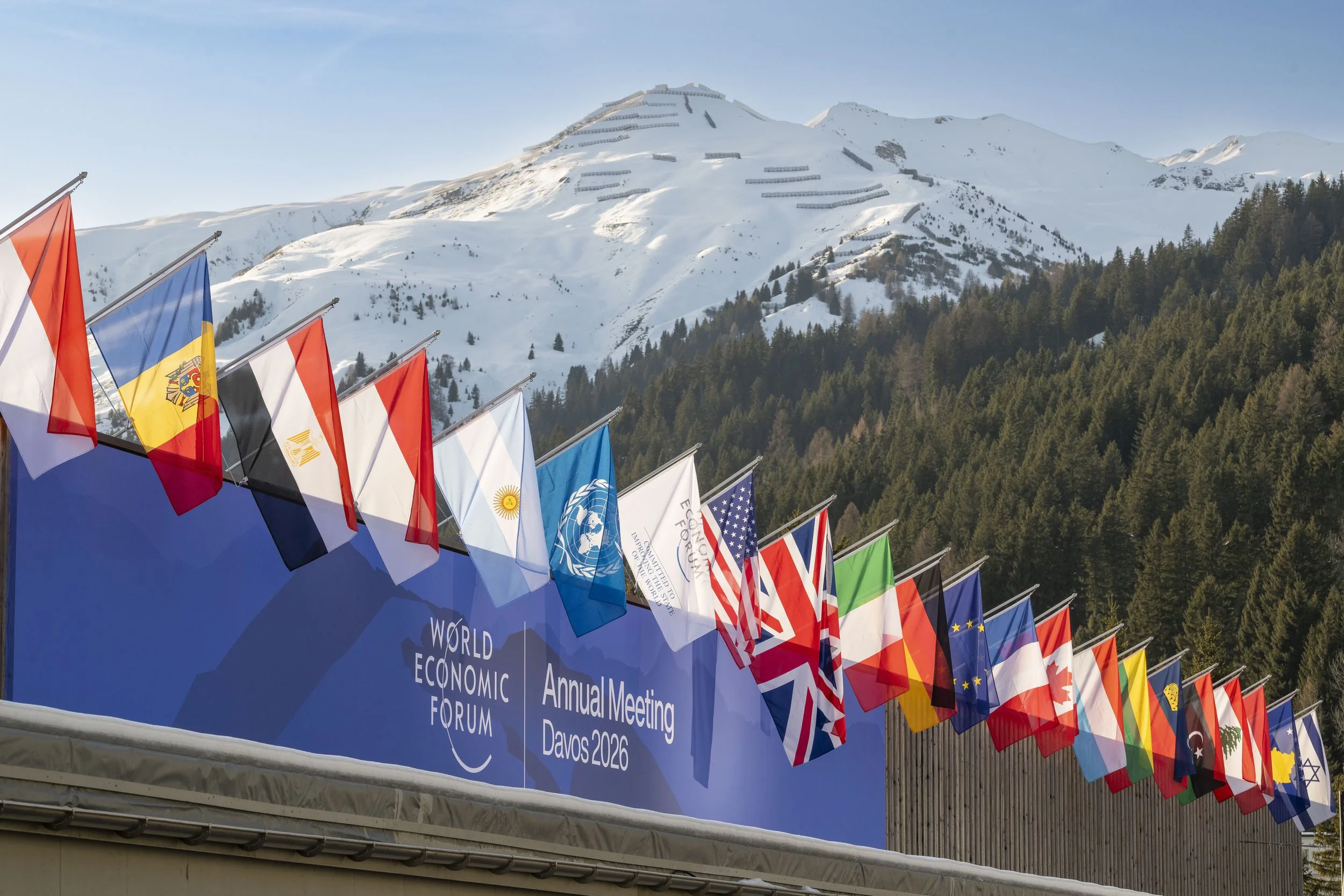
Country flags outside the venue of this year’s World Economic Forum in Davos, Switzerland | WEF
BY AMOS WEMANYA
This year’s World Economic Forum in Davos, Switzerland, comes at a time when the world is in a geopolitical spin.
It’s the first time political and corporate leaders have met since US President Donald Trump raided Venezuela and captured its leader, Nicolas Maduro, and threatened to invade Greenland.
In Davos on Tuesday, Trump repeated his desire to acquire the semiautonomous Danish territory in the Arctic.
World leaders are also meeting in the Swiss Alps at a time when the gap between the socioeconomic rhetoric and the lived realities of especially frontline communities is widening. It’s undeniable that the world is facing interlocking crises, namely, record-breaking temperatures, increasingly severe floods and droughts, collapsing ecosystems, and growing socioeconomic insecurities.
Meanwhile, wealth at the top continues to grow, granting a small group of individuals and corporations extraordinary economic and political influence. How, then, do leaders keep claiming that we lack sufficient resources to address climate change, development, and inequality?
“The world’s wealth has not disappeared; it is concentrated in a few hands in ways that limit its impact on those who need it most. ”
Africa continues to bear the deadliest consequences of the climate crisis. Mozambique President Daniel Chapo cancelled his trip to Davos as his country experiences dreadful floods that have killed more than 100 people.
In May last year, floods killed 200 people in Nigeria, although the toll is feared to be as high as 700. In the Democratic Republic of the Congo, heavy rains caused the Ndjili River to burst its banks in Kinshasa, killing 33, while flash floods in South Kivu claimed over 100 lives.
Cumulatively, these events have destroyed homes, roads, schools, bridges, and other critical infrastructure, cutting off communities from markets, healthcare, and education.
Across the continent, our smallholder farmers are experiencing shrinking yields due to unpredictable rainfall, soil degradation, and heat stress. This has put food security for millions of our people at grave risk.
Yet these climate impacts aren’t happening in isolation.
They are occurring against the backdrop of crippling debt and constrained fiscal spaces for most African economies. For governments, this means making nearly impossible trade-offs between debt repayment and investment in essential services and climate adaptation.

African leaders at the Africa Climate Summit (ACS2) in Addis Ababa | PSA Media
At the same time, those most responsible for climate breakdown continue to influence global policy to protect their interests. The world’s wealthiest individuals and corporations contribute disproportionately to emissions through excessive consumption, carbon-intensive investments, and lobbying that weakens or delays climate action.
In the United States alone, oil and gas companies spent an estimated $ 2 billion between 2000 and 2016 to influence climate policy and kill climate laws, according to Oil Change International.
These power dynamics go beyond climate policy into trade rules, tax systems, and financial regulations, reinforcing structural inequalities within and between countries.
This is why the ongoing discussion at the United Nations on a global tax treaty is timely and matters. These new international tax rules aim to curb illicit financial flows, limit aggressive tax avoidance by multinational corporations and billionaires, and restore taxing rights to countries where real economic activity occurs.
For African economies, these negotiations are not merely abstract exercises. They speak directly to the persistent bleeding of public resources through profit shifting, extractive contracts, and opaque financial arrangements that drain billions of dollars each year from health systems, infrastructure budgets, and climate adaptation efforts.
In a world marked by escalating conflicts, where resources are stockpiling, and countries are militarising, predictable and fair tax revenues are essential for fiscal resilience and political stability.
Yet progress remains slow and contested. Powerful states and corporate actors continue to resist proposed changes to rebalance taxing rights toward source countries and constrain the ability of capital to escape public accountability.
Without meaningful change, African countries remain trapped in a cycle of debt servicing, climate response, and absorption of global shocks while being denied access to their own generated wealth.
These structural imbalances make it difficult to finance urgent climate solutions such as climate adaptation, which aren’t optional but a matter of survival in Africa.
Investments in resilient roads, bridges, flood defence, irrigation systems, and early-warning systems help save lives and livelihoods. But to implement them, Africa requires predictable and substantial funding.

A road damaged by heavy rainfall in Garissa County in Northern Kenya | PSA MEDIA
Multiple reports, including this one by the UNEP, show that current climate finance flows to developing countries are insufficient. These resources are often provided as loans rather than grants. They are also tied to bureaucratic conditions that slow urgent response to climate impacts. Meanwhile, multinational corporations continue to exploit loopholes in international tax systems while extracting resources from Africa, crippling economies.
Wealth inequality and climate vulnerability reinforce each other. The richest are insulated from immediate climate impacts, while those least responsible, smallholder farmers, low-income urban communities, women, and Indigenous people face the harshest consequences. They are also largely excluded from decision-making spaces, while corporate and billionaire interests dominate global forums.
Addressing these gaps requires confronting financing directly.
Progressive and effective taxation of extreme wealth and excess corporate profits is not only fair, but it is also practical.
Captured resources can fund climate adaptation, resilient infrastructure, social protection, and the clean energy transition.
“Transforming global tax rules to ensure profits are taxed where economic activity occurs is central to creating a sustainable financial foundation for development and climate resilience.
”
As world leaders deliberate on different global issues this week, they must be careful not to reinforce incremental solutions at the expense of discussions that truly transform global economic structures.
For communities whose homes and infrastructure have been destroyed, the Mozambicans battling fatal floods, and Africans experiencing failing crops, the challenge is not the absence of resources; it is the absence of governance and political will to direct wealth toward adaptation and resilience.
Until that changes, global forums will debate scarcity even as wealth continues to accumulate at the top.
Amos Wemanya is a Senior Climate Advisor at Power Shift Africa