
PARTICIPANTS AT NAIROBI MEETING DEBATE WHY KENYA’S CLEAN POWER HAS YET TO TRANSLATE INTO AFFORDABLE ENERGY

Participants from government agencies, energy think tanks, academia and civil society. Double Tree by Hilton, Nairobi. Friday 18th September, 2026.
Kenya’s success in renewable electricity generation has not automatically delivered cheaper energy for households and businesses, prompting energy experts, civil society organisations and researchers to examine where the costs are coming from and what can be done to bring down the burden on consumers.
At a meeting convened by Power Shift Africa in Nairobi this morning, participants from government agencies, energy think tanks, academia and civil society scrutinised the country’s “green electricity, expensive energy” paradox and tested the evidence and policy proposals underpinning an upcoming report on how Kenya can make its renewable energy potential both accessible and affordable.
The discussion examined whether the characterisation of Kenya as a country with predominantly renewable electricity but expensive energy remains accurate, where the costs arise, and whether proposed interventions are economically sound and feasible.
Mr Amos Wemanya of Power Shift Africa set the stage with the suggestion that the phrase “green electricity, expensive energy” should be treated as a problem statement rather than a conclusion.
“The central proposition is that Kenya has a predominantly renewable electricity system, yet energy remains expensive for households and businesses,” he said, noting that the analysis needs to establish whether the characterisation remains accurate and identify the sources of costs, including generation, electricity networks, power-purchase contracts, financing, taxes and fuel.
“We should avoid implying that renewable generation itself is the principal cause of high electricity prices,” Mr Wemanya warned.
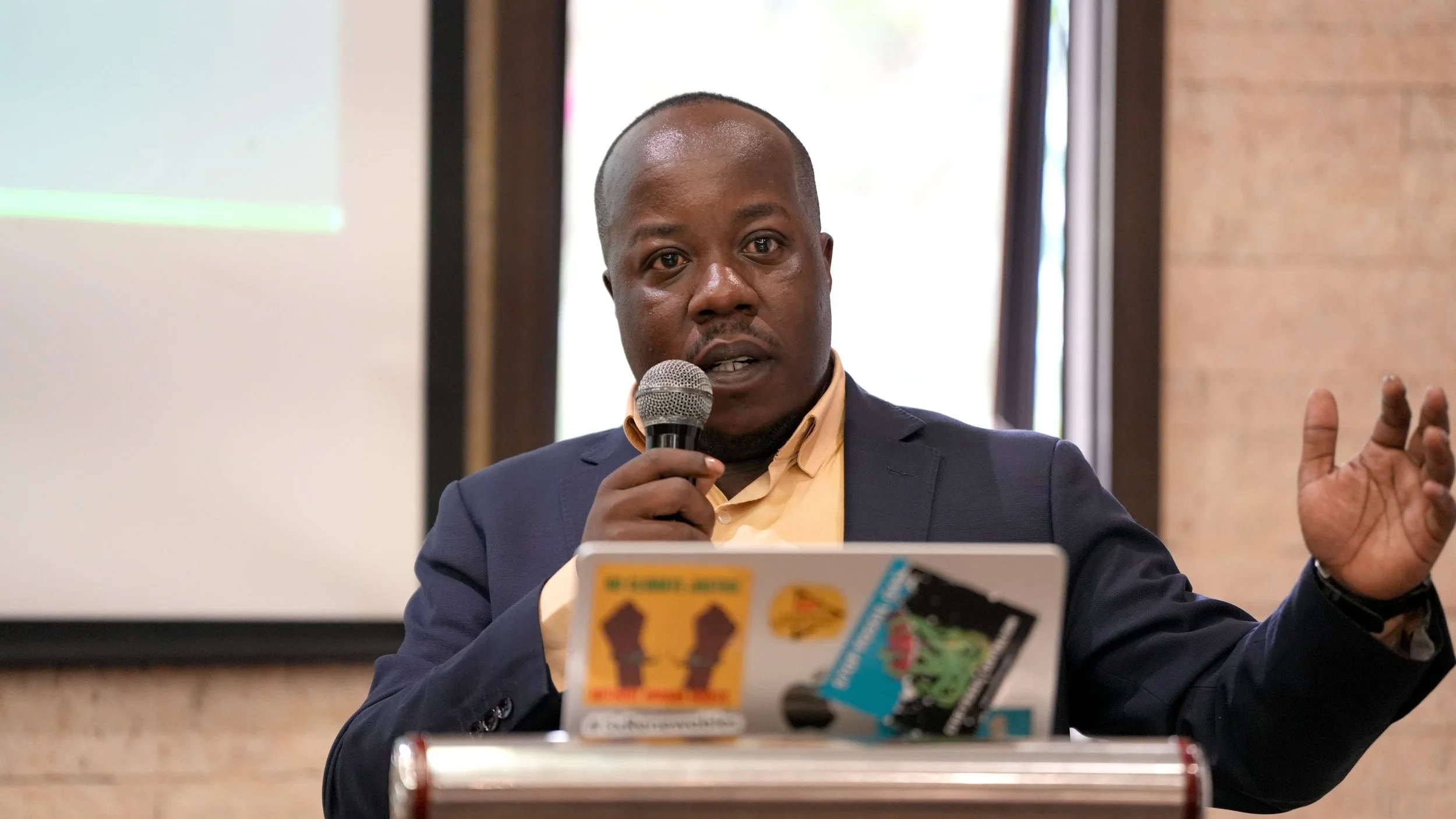
Mr. Amos Wemanya, Power Shift Africa.
Clean electricity, high energy costs
Kenya has made substantial progress in renewable electricity generation, and Mr Mohamed Adow, the Founder and Director of Power Shift Africa, reminded the meeting that close to 90 per cent of the country’s electricity generation comes from geothermal, hydro, wind and solar. Electricity access has also expanded significantly, rising from about 32 per cent of the population in 2013 to roughly 84 per cent by 2023, according to government figures.
Yet the expansion of renewable generation and electricity access has not eliminated the factors that make energy expensive. Mr Adow pointed to recent increases in electricity charges, saying charges had risen essentially every month from April through August 2026, with the increases driven largely by the fuel energy cost charge and foreign-exchange adjustments rather than the cost of renewable generation.
The result, he argued, is a contradiction at the heart of Kenya’s energy transition: the country has one of the world’s cleanest electricity systems while consumers remain exposed to the cost of imported fuels and currency movements.
Thermal generation is particularly significant because plants using imported fuel expose consumers to fluctuations in international fuel prices and the exchange rate. But, for Mr Adow, the problem extends beyond electricity. Kenya remains heavily dependent on imported petroleum, with transport accounting for more than three-quarters of petroleum consumption and relying extensively on imported fuel. This means that a cleaner electricity grid provides limited protection from international oil-price shocks for the transport sector and the wider economy.
“When Hormuz convulses, a clean grid offers no shield to the matatu, the boda boda, the tractor, or the food that moves on diesel,” he said.
The dependence raises a broader question about Kenya’s development path, specifically whether countries seeking to industrialise now can increase incomes while avoiding prolonged dependence on carbon-intensive and import-dependent energy systems.

Mr. Mohamed Adow, Founder and Director, Power Shift Africa
The cooking challenge
The energy transition also looks different when viewed from the kitchen. Despite Kenya’s renewable electricity achievements, around 69 per cent of households still cook with firewood and charcoal, and the burden of traditional cooking fuels falls disproportionately on women and girls.
Ms Jacqueline Kimeu of Christian Aid said affordability is often cited as the main reason households do not use electricity for cooking, but the reality is more complicated. She pointed to instances where electric cooking can already be cheaper than gas for particular meals, including cooking githeri, one of Kenya’s main staples, made from maize and beans.
“We need to challenge some of the myths around electric cooking,” Ms Kimeu said, arguing that the challenge should partly be about how existing financing and electrification programmes are designed. Government and bank-financed electrification programmes already provide significant financing, she noted, and raised the question of whether clean cooking can be integrated more deliberately into programmes that are already expanding electricity access.
Kenya’s clean-energy success also sits alongside a striking access gap in communities hosting electricity-generation infrastructure, and Ms Kimeu said some communities around power-generation sites continue to rely on rudimentary cooking fuels, including cow dung.
“We are exporting the power generated in these communities while leaving some of the communities themselves without meaningful access to the electricity around them,” she said. The problem, therefore, is not necessarily a lack of money alone, she argued. Planning must also ensure that electricity is affordable and usable for host communities.
Ms Kimeu also called for greater attention to local manufacturing of clean-energy technologies, including electric cooking appliances. The question, she said, should be where available finance is flowing and whether local businesses and social enterprises can access it.
“We need to look at finance as a community enabler,” she said.

Ms Jacqueline Kimeu, Christian Aid
Who should pay for the transition?
Financing the energy transition emerged as another major area of debate, particularly the proposal to introduce an excess-profits tax along the petroleum supply chain. Ms Maria Nhonjera of Christian Aid said there were legitimate questions about the potential for capital flight if wealthy individuals and corporations face higher taxation. She argued, however, that these risks need to be assessed rather than assumed.
The debate therefore extends beyond whether additional taxation is possible to questions of design, implementation and accountability, and Ms Nhonjera questioned whether concerns about capital flight could sometimes be used to justify avoiding taxation or create opportunities for tax avoidance. For her, evidence is needed to establish whether the potential benefits of such a measure would outweigh the risks.

Ms Maria Nhonjera, Christian Aid
Looking inside the electricity bill
Ms Wairimu Manyara of Law for Energy Transitions Africa (LETA) said affordability also requires closer scrutiny of how electricity is procured and transmitted, and how the resulting costs reach consumers. Kenya faces a need to expand both generation and transmission capacity, particularly following the lifting of a moratorium on new generation projects. But the expansion must be managed in a way that does not push electricity beyond what households and businesses can afford.
Ms Manyara argued that consumers should be able to distinguish between transmission and generation costs on their electricity bills. Such greater transparency, she argued, would allow consumers to understand what they are paying for and where costs are arising. She also proposed allowing captive power plants to sell excess electricity back to the grid, potentially making better use of electricity generated outside the conventional utility system.

Ms. Wairimu Manyara, Law for Energy Transitions Africa (LETA)
Transport, health and social justice
The energy affordability debate also extends to transport. Mr Meshack Mboya of Power Shift Africa said Kenya needs to reduce its dependence on imported fuels while protecting people from the impacts of rising energy costs. He noted that transport electrification should be viewed partly as a public-health intervention because vehicle emissions expose people to harmful pollutants, including particulate matter. The impacts, he continued, are experienced by drivers, hawkers, pedestrians and other people who spend significant amounts of time around traffic.
But electrification alone will not deliver the transition, Mr Mboya said. Government policy will be required to create the conditions for electric mobility to expand. He pointed to Ethiopia,
where restrictions on imports of fossil-fuel vehicles have been accompanied by efforts to promote electric vehicles and local manufacturing.
For Kenya, he said, the transition also requires development of local value chains around charging infrastructure. As electric mobility expands beyond major urban centres, reliable charging infrastructure will need to become available across the country. That means treating charging networks and electricity reliability as part of the same infrastructure challenge.

Mr. Meshack Mboya, Power Shift Africa
From access to productive use
Participants also stressed that expanding electricity connections should not be the final measure of success. Rural communities across Kenya are gaining access to electricity already, but the next question is how that electricity can support productive economic activity, particularly agriculture. This is important because reliable and affordable electricity could support cold storage, processing and other activities that help farmers preserve produce and reduce losses, particularly when weather conditions disrupt production.
Energy storage was also identified as an important part of the equation. Battery storage and pumped-storage capacity could help address fluctuations in supply and provide greater flexibility to the electricity system. Participants argued that power-purchase agreements should increasingly take account of storage, particularly as Kenya continues to expand variable renewable generation.
Reducing thermal generation could also have implications beyond emissions. Greater reliance on imported fuel exposes the electricity system to both international fuel prices and foreign-exchange movements. Cutting that exposure could therefore improve energy security as well as reduce some sources of cost volatility.