Romance without finance? Why Global Goal on Adaptation is the unkept bargain of developed countries
What we need now is not just better metrics — even though useful — but a renewed political commitment to elevating adaptation as a global priority; one that puts the cost of resilience into practice and acknowledges that the adaptation needs of one country are the shared responsibility of all.
By Patience Agyekum and Amy G. Thorp
For decades, adaptation under the UNFCCC remained the ugly stepsister of global climate action. Overshadowed by mitigation, its progress stalled, and critically underfunded, it appeared to be a low political priority and largely confined to small-scale, incremental projects. At the root of these delays lay a Global North fear that prioritising adaptation might divert attention away from cutting greenhouse gas emissions. In the global climate change landscape, visibility often dictates funding flows. However, adaptation has lately gained political traction, both within and outside UNFCCC. At the heart of the renewed attention is the Global Goal on Adaptation (GGA), enshrined in Article 7 of the Paris Agreement and akin to the 1.5 °C goal. Conceived and championed by the African Group of Negotiators (AGN), the GGA represents a concerted effort from developing countries to reframe adaptation as a collective global priority and goal, helping elevate it to achieve material and political parity with mitigation.
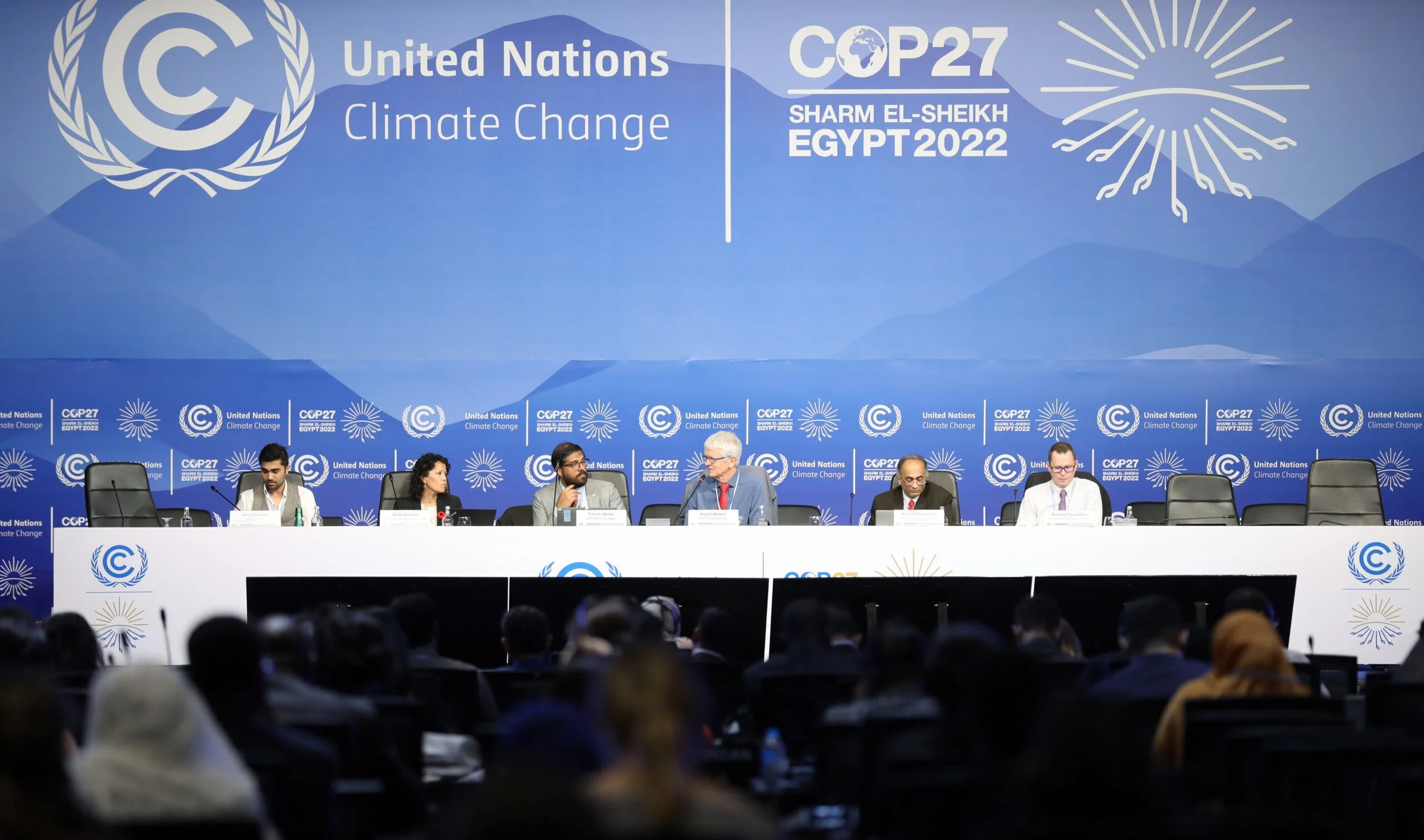
27th United Nations Climate Change Conference of the Parties (COP 27). Sharm el-Sheikh, Egypt. December 2022.
How GGA has progressed since Paris
The initial fanfare surrounding the adoption of the GGA quickly faded, with momentum stalling for nearly five years as work on mitigation advanced steadily. Frustration from developing countries eventually helped revive the adaptation agenda, and at COP26 in 2021, parties launched the Glasgow–Sharm El-Sheikh (Glass) Work Programme to give meaning to the GGA, clarify what it means in practice, how it can be achieved, and how progress can be measured. Through workshops and Party submissions from parties and other non-state actors on defining the GGA from COP26 to COP28 in 2023, the United Arab Emirate Framework for Global Climate Resilience (UAE-FGCR) was adopted. Many consider this framework as the turning point for the GGA, with countries finally agreeing on a set of 11 targets: seven of them thematic ( food and agriculture, water, health, ecosystems, poverty and livelihoods, cultural heritage, infrastructure), and four related to the adaptation policy cycle that will help countries assess and strengthen their national adaptation planning and implementation processes. At the same time, the two-year UAE-Belem work programme was also launched to develop indicators to assess progress across the 11 targets.
Shift from cooperation to metric game
The negotiations and discussions that have followed the adoption of the UAE-FGCR in 2023 and the Belem Adaptation Indicators at COP30 in 2025 have largely revolved around how adaptation is measured, which indicators are most useful, and how to balance global applicability with local relevance. While these debates are important for measuring progress and tracking accountability, they have also reduced adaptation, which is vital to communities’ livelihoods and wellbeing, to a mere technical exercise and jargon. In the process, big words and circular arguments have once again quietly shifted political attention away from the big elephant in the negotiation room: the means to support implementation.
The central idea underpinning the GGA is about enhancing global cooperation to collectively reduce vulnerabilities, enhance adaptive capacity, and build resilience. Yet it now risks being reduced to a technical tool for measuring efficiency, one that could inadvertently restrict access to finance for some vulnerable countries. The success of the GGA will not only rest on the sophistication of its indicators, but ultimately whether climate-vulnerable countries and communities have access to the finance, technology and capacity building support needed to reduce their vulnerability and strengthen resilience in practice.
For Africa, the GGA must address historical responsibility, the structural drivers of vulnerability, and mobilise global solidarity and support for communities to secure their food, water and health systems; protect livelihoods and ecosystems; build climate-resilient infrastructure; and withstand increasingly severe climate impacts.
No resilience without finance
The provision of finance from developed to developing countries, as part of their means of implementation support, has always been a contentious issue within the UNFCCC. Developed countries often claim to have met their obligations, but adaptation finance for developing countries remains wholly inadequate and far below the $310-to-$365 billion annual gap. The fact that the majority of funds continue to flow into mitigation projects not only leaves adaptation underfunded, but also illuminates the political prioritisation of mitigation over adaptation by developed countries. Worse still, Africa only received one-fifth of its annual adaptation finance needs in 2021/2022, and the majority of this finance came in the form of loans. This means that African countries are not only more debt distressed, but are also spending more from their domestic budgets on adaptation than the support they receive.
Amy G. Thorp is the Programmes Manager while Patience Agyekum is the Climate Adaptation and Campaigns Officer at Power Shift Africa.