The adaptation trust jar is not half-full; COP30 completely emptied it
By Amy Giliam Thorp
Building trust is not easy or fast. Neither are flashy statements and the grand promises declared within and outside negotiation halls of climate summits enough to forge the trust required.
In Charles Feltman’s the Thin Book of Trust, published in 2008, trust is defined as “choosing to risk making something you value vulnerable to another person's actions.” The core premise of his book is that trust is fashioned through small actions rather than grand gestures.
Trust is also like a marble jar, as American academic and podcaster Brené Brown’s work on daring leadership reminds us. Marbles go in when we are reliable (we do what we say we are going to do), accountable (own our mistakes), and act with integrity (choose courage over comfort); they are removed from the jar each time we lie or break promises.
This metaphor could not be more relevant to how climate negotiations unfold during annual climate summits, and COP30 was no different.
In global climate negotiations, trust might look like timely delivery of pledges (reliability), honouring legal obligations (accountability), no backtracking on commitments (again, reliability), and not shifting responsibility (integrity). Trust has the potential to move the needle on global climate action, while distrust can hamstring further progress.
This made COP30 – billed as the ‘adaptation COP’ and ‘the COP of truth’ – a crucial moment to rebuild trust in multilateralism generally, and adaptation, more specifically. It was the first time that adaptation would finally take center stage after years of living in mitigation’s shadow.
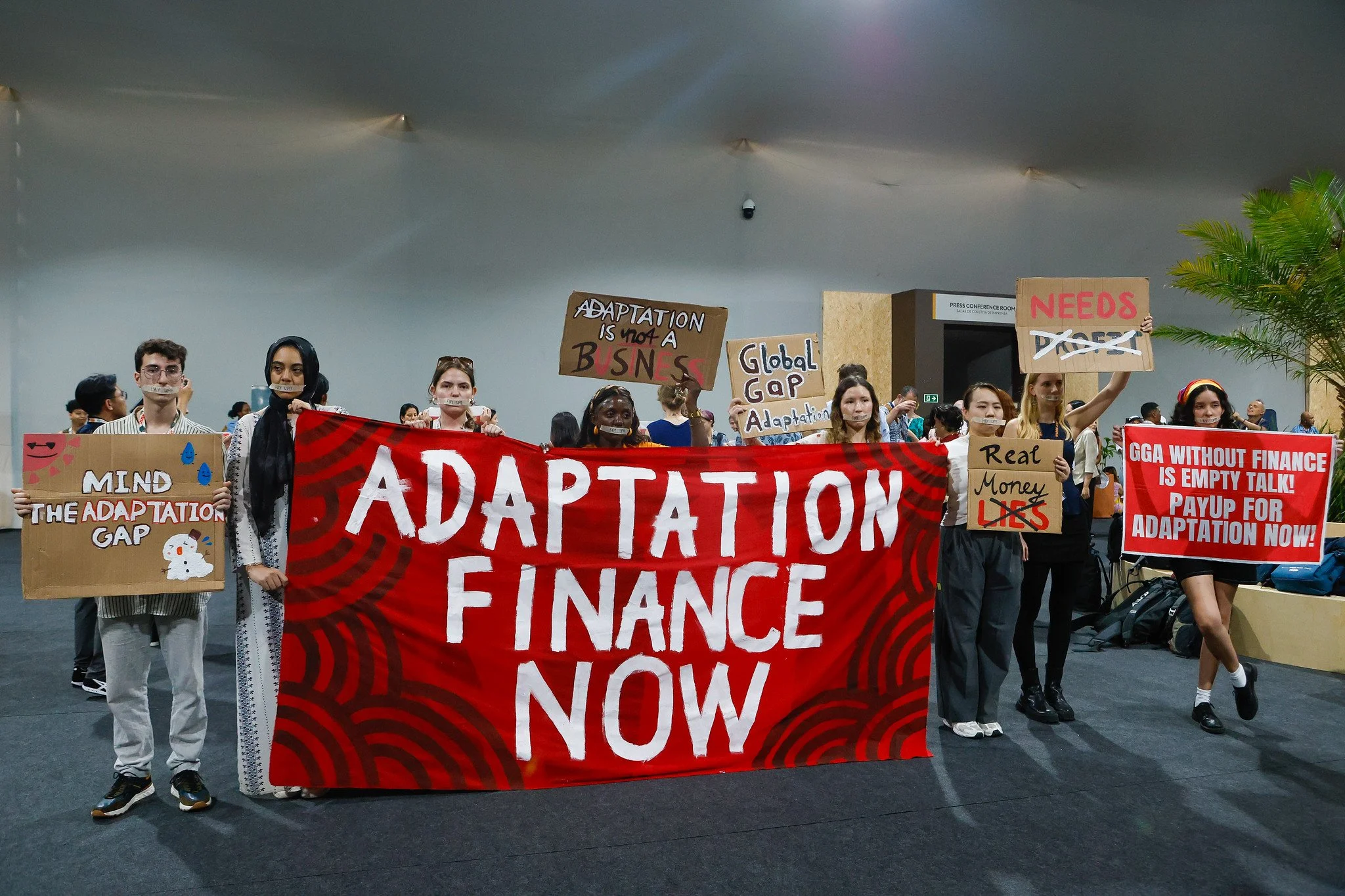
Vulnerable nations hoped this would be the political turning point for adaptation and an opportunity to deliver two long-awaited milestones: a new adaptation finance goal to replace the Glasgow doubling pledge, and the adoption of a robust set of indicators to track progress towards the Global Goal on Adaptation.
After years of unmet promises and a COP President who finally shone the spotlight on adaptation, COP30 offered developed countries another opportunity to restore trust in their commitment to the goals and their responsibilities outlined in the Paris Agreement, including achieving a balance between mitigation and adaptation finance.
Instead, climate-vulnerable countries ended up with hollow statements, political evasion, and backtracking by developed countries. The GGA and Mutirão decision texts related to adaptation are riddled with ambiguity, shirking of responsibility and further delays in adaptation, particularly finance.
Given the widening adaptation finance gap and escalating climate impacts linked to rising temperatures, Africa and Global South countries travelled to COP30 with a clear objective: secure a scaled up, predictable, grant-based adaptation finance commitment that responds to countries’ needs. However, entrenched faultlines between developed and developing countries on adaptation finance reared their head yet again. Tensions flared around the figure for the goal, the link to Article 9.1 (finance) of the Paris Agreement, and whether to include it in the GGA or Mutirão decisions.
These were not abstract negotiation points. For many countries, adaptation finance determines whether communities can move beyond merely surviving to preparing for the next flood or drought and even achieving prosperity.
Many headlines suggest COP30 delivered progress on adaptation finance, but the devil is in the detail. And the details tell a different story. Although the final decision refers to “efforts to at least triple adaptation finance”, this language is politically evasive and obscures who is responsible. First, it dilutes developed countries' legal obligation under Article 9.1 of the Paris Agreement to provide adaptation finance to developing countries.
Second, the "call for efforts” broadens the commitment to include other actors such as public finance institutions and the private sector, which will likely lead to more loans and deeper debt distress for already vulnerable nations. Additionally, private finance is no silver bullet for adaptation: it has no accountability under the Paris Agreement, and adaptation is largely a public good offering limited financial returns, so it's unlikely to mobilise the scale of investment needed.
Finally, tripling adaptation finance might sound ambitious on paper, but the pledge lacks a baseline and pushes delivery out to 2035, despite already bleak progress towards the doubling goal of $40 billion by 2025 and further declines expected in climate finance. Together, these ambiguities and delays risk compounding the injustices faced by frontline communities.
Another prominent adaptation outcome from COP30 was the adoption of a set of 59 indicators to track progress towards the 11 Global Goal on Adaptation (GGA) targets. These include thematic targets like food and agriculture, water and sanitation, biodiversity, health, and targets related to the full adaptation policy cycle.
Although the COP30 Presidency and many groups prioritised adoption of the GGA indicators, concerns lingered among developing nations that the 100-indicator draft list prepared by 78 experts was not fit for purpose, particularly due to weak means of implementation (MoI) indicators on finance, capacity building, and technology transfer.
Every delayed pledge or diluted commitment over the years has removed marbles from the adaptation trust jar, bringing the stakes and tensions of these negotiations into sharp focus.
As negotiations got underway, fault lines over the GGA quickly deepened. Delegates were divided between adopting the full list of indicators at COP30 or delaying adoption to refine them further. On top of concerns over domestic budget indicators and weak MoI indicators, GGA divisions were also linked to disputes on Article 9.1 (finance) obligations and the need for the indicators to be accompanied by a new, quality adaptation finance commitment.
In the end, COP30’s GGA outcomes offered only a lukewarm step forward, riddled with trade-offs and technical shortcomings. While problematic indicators on national budgets, national legislation, and private finance were dropped, opaque last-minute revisions to the indicator list behind closed doors are concerning. They raise more questions than they answer, such as whether the 59 eventual indicators were arrived at through an inclusive approach or at the behest of certain interests over others.
The whittling down of indicators also dismantled two years of expert work, leaving many not only unclear and unmeasurable, but also technically flawed. Furthermore, the decision text is riddled with contradictions related to the next steps on indicator use and follow- up work through the Belem-Addis adaptation vision and implementation under the already existing Baku Adaptation Roadmap.
Ultimately, adopting a flawed indicator list without a strong, grant-based adaptation finance goal is not only unjust, but also blatantly ignores the Global South and Africa’s call for scaled support to meet escalating climate risks.
COP30 revealed that continued failure to deliver on promises means the adaptation trust jar is not half-full; it’s completely empty.
As we move into 2026 and towards COP31, the adaptation trust jar can be rebuilt, but it requires more than words: marbles must be placed back; one fulfilled pledge and resource delivered at a time.
Amy Giliam Thorp is the Programmes Manager and Adaptation Lead at Power Shift Africa.